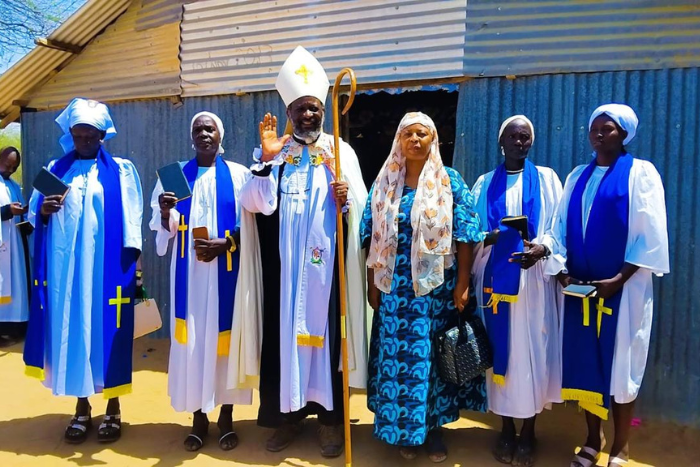
Photo Credit: The Diocese of Garissa
The Rt Revd Dr Francis Omondi Otieno (Bishop of Garissa in the Anglican Church of Kenya) has encouraged displaced Christian communities in refugee complexes in Dadaab in North-Eastern Kenya within his Diocese of Garissa. The Diocese is actively working to provide pastoral and humanitarian support in the region.
Bishop Francis says that he has been involved in supporting the refugees in various ways since the camp's inception in the 1990s. But since becoming a bishop last year (May 2025), he felt that the diocese should do more to ‘craft ways of integrating the Anglicans here in our diocese’, including those in Dadaab.
He explained that they ‘have now organised and established parishes and churches in the complex that care for Anglicans and [are] working with the Anglican community to support the other Christians in the ecumenical movement growing in the complex.’
Visiting the Dadaab Refugee Complex between January 31st and February 1st, 2026, the weekend’s activities included the dedication of two churches, the commissioning of four new lay persons, and confirmations for 60 people in the refugee camps of Hagadera, Ifo Main, Ifo Two, and Daghale.
Bishop Francis said, ‘This episcopal visit to the Dadaab Refugee Complex was a prophetic act, witnessing God’s work through our messages and presence.’ Bishop Francis also preached at various gatherings of Christians across the settlements, including an ecumenical service at Ifo Two and a prayer rally with over 600 attending.
At every turn, Bishop Francis reported being inspired by the faith and prayerfulness of the Christian Communities. During his visit, he met a congregation of Sudanese people, currently attending 'church under a tree'. The bishop blessed the ground where they pray will one day be a church building.
The Dadaab Refugee Complex
The Dadaab Refugee Complex is one of the oldest and largest refugee camps still operating. Spanning 3 complexes (Dagahaley, Ifo and Hagadera), the site was originally founded in 1991 when those fleeing the civil war in Somalia crossed the border into Kenya. Since then, there have been several more influxes of refugees and asylum seekers.
Bishop Francis explained, ‘For more than three decades, Kenya has hosted refugees and asylum-seekers from other countries in the Dadaab refugee camp in Garissa County. The camp hosts over 420,000 refugees and asylum seekers who fled violence, political instability and hunger from Somalia (56.9%), South Sudan (23.4%), and the Democratic Republic of the Congo (7.6%), making up approximately 50,000 Christian refugees in the Dadaab.’
The Kenyan Government’s Department of Refugee Services (DRS) is responsible for the management and coordination of refugee affairs, with technical support from the United Nations Refugee Agency (UNHCR).
As one of the longest-established refugee complexes, many residents have lived there for decades and there are now third generations being born in the camp. A largely arid and impoverished region, there is a constant strain on resources. The potential for conflict is also high - with people of different cultures and faiths, all living in close quarters.
‘In God’s Kingdom, there are no foreigners’
On his visit, Bishop Francis witnessed the hardships faced by those in the camps, but also found his time there uplifting in the light of the people’s generosity and God’s divine provision. ‘The presence of God was palpable as the congregations worshipped with jubilation, singing and ululating. Their excitement was a thanksgiving to God, an exuberance that concealed the trauma they carried. Despite their hardships, their hospitality was generous, offering a variety of cuisine despite the biting lack they had faced since the truncation of USAID and the depletion of donor funds. The host committee told me, “We were unsure how we would manage certain needs, including food, but God supplied abundantly, including refreshments… Truly, God uses people to answer prayers.”’
The Revd Peter Dau, the priest at St. John’s Ifo, remarked, 'The bishop shared powerful teachings on the love and faithfulness of God, reminding us that when God makes a promise, He fulfils it…His presence brought great encouragement and spiritual renewal.’ Revd Peter went on to say that the spirit of Bishop Francis’ messages was that ‘In God’s Kingdom, there are no foreigners… As refugees, we felt accepted and loved, and we were shown that we have brothers, sisters, mothers and fathers in Christ.’
Across the Anglican Communion, churches and Anglican groups are involved in advocacy work and humanitarian aid for refugees. At the recent Progress Review of the United Nations Global Refugee Forum (GRF), the Most Revd Dr Maimbo Mndolwa (Archbishop and Primate of Tanzania and the Anglican Communion's representative to the Multi-Religious Council of Leaders of the UNHCR), reiterated the Communion’s commitment to advocate for refugees at the international and local levels.
Learn more about the Diocese of Garissa in the Anglican Church of Kenya.
Learn more about the Dadaab Refugee Complex on the UNHCR website.
Read about the Anglican Communion’s advocacy work on the refugee and migration crisis at the Global Refugee Forum.