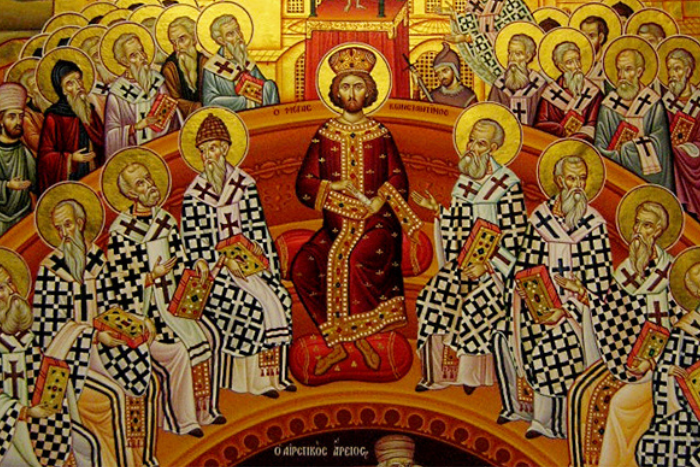
Photo Credit: (photo: Wikimedia Commons / Public Domain)
His Holiness Pope Leo XIV and His All Holiness Ecumenical Patriarch Bartholomew I, are meeting in Turkey for a momentous pilgrimage to mark the 1700th anniversary of the Council of Nicaea. This ecumenical gathering will involve other leaders and representatives of Christian World Communions and faith groups. The Secretary General of the Anglican Communion, the Rt Revd Anthony Poggo, will attend to represent the Anglican Communion.
The pilgrimage of Pope Leo XIV and Bartholomew I is significant. It strengthens the relationship between the Roman Catholic Church (representing 1.3 billion Catholics worldwide) and the Orthodox Church (300 million worldwide), and emphasises a desire for greater unity after centuries of division since the Great Schism of 1054, and the unity of all Christians.
The primary purpose of the pilgrimage is to commemorate the Council of Nicaea, a pivotal event where early church leaders formulated the Nicene Creed that is still central to most Christian faiths today. The Council of Nicaea took place in the ancient city of Nicaea in 325 AD in the former Roman Empire, which is now the present-day city of znik, in northwestern Turkey, about 70 miles from Istanbul.
Pope Leo’s visit from 28 November – 2 December combines times for prayer, dialogue, visits to nine historic religious sites and meetings with civil society groups. The Pope will also spend time in Lebanon. He has summed up the message of his trip by saying that 'all men, women can truly be brothers and sisters, in spite of differences, in spite of different religions, in spite of different beliefs'.
On 28 November Pope Leo and Bartholomew I will attend an Ecumenical Prayer Service near the archaeological excavations of the ancient Basilica of Saint Neophytos, a now submerged church in Lake Iznik, which was discovered in 2014. While the basilica was built after the First Council of Nicaea, there is speculation that it served as a possible site for some of the council's later meetings.
Of the symbolism of this commemoration and pilgrimage, the Orthodox Times writes, ‘Despite the wounds of schism, the Creed continues to echo as a shared heartbeat, a reminder that East and West still acknowledge the same mystery of Christ’s incarnation.’
Time will also be given to interfaith dialogue, with a focus on promoting peace in the region. The Pope's itinerary includes visits to sites like the Sultan Ahmed Mosque (Blue Mosque) on 29 November, to engage in dialogue with Muslim leaders and community members, showing a commitment to fostering positive relationships between faiths. The Ecumenical Patriarch will also host a Doxology at his Patriarchal Church on the 29th, and will preside at the Divine Liturgy on the 30th, before Pope Leo heads to Lebanon.
The significance of the Nicene Creed
The First Council of Nicaea was convened in 325 by Emperor Constantine and is regarded as a pivotal moment in Christian history. It was the first ecumenical council, bringing together bishops from across the Christian world to address theological disputes and unify Christian doctrine. One of its most significant achievements was the formulation of the Nicene Creed, which affirmed the consubstantiality (or oneness) of the Son with the Father. It was, therefore, instrumental in affirming faith in the triune God (the Trinity of Father, Son and Holy Spirit) as Christians understand it still. This creed became a foundational statement of Christian orthodoxy, shaping the theology of mainstream Christianity for centuries.
An opportunity for visible unity
The Secretary General of the Anglican Communion, the Rt Revd Anthony Poggo, is attending and said: ‘It is a privilege to join with other Christian traditions to commemorate this significant anniversary in our shared history. The world today can feel so fragmented and divided, but Christ calls the Church to be one. It’s my prayer that, inspired by that first Council of Nicaea, our World Communions will continue to find ways to walk closer as we strive for the visible unity of the Church, share the hope of Christ and work to broker peace in the world.’
For more information
Read about the Pope’s schedule during his visits to Turkey and Lebanon.
Learn more from the visit on Vatican News.
Learn more about the Ecumenical Partriarchate.
Learn more about the historic religious sites being visited by Pope Leo XIV.