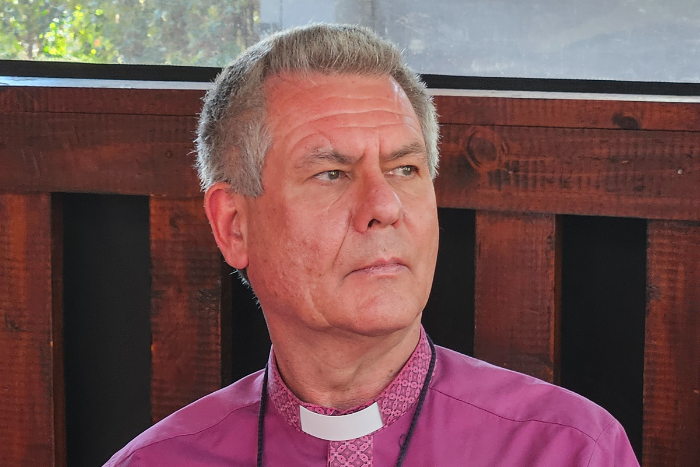
Photo Credit: Bishop of Saint Mark the Evangelist
The Rt Revd Luke Pretorius, Bishop of Saint Mark the Evangelist in the Anglican Church of Southern Africa, shares his enthusiastic interest in science and how it connects with his understanding of faith and mission. As a Lead Science Bishop, he represents his Province on the Anglican Communion Science Commission.
A deep interest in science
Bishop Luke recalls having a keen interest in science from a young age. Members of his family worked in medicine and he developed a deep respect for those in the field of science. He remembers watching the Hubble Space Telescope ‘with great interest’ and enjoys learning about the wider cosmos.
Inspired by Galileo: The Bible and the ‘Book of Nature’ help us understand the world
Bishop Luke shares his conviction that his faith is ‘not threatened by science’. He’s inspired by Galileo Galilei - a key figure in the Scientific Revolution in the 1500s. Galileo’s ‘Two Books’ concept, referred to the Bible and ‘The Book of Nature’, as ways of understanding the world. In this view. Galileo held that the Bible reveals truths about faith and morality, while ‘The Book of Nature’, written in mathematical language, reveals truths about the universe through scientific observation and reasoning.
On Galileo, Bishop Luke says: ‘He's not saying [science] replaces the Bible, or contradicts the Bible in any way, but is saying if you want to know more about God, we not only are forced to turn to scripture, but we must also turn to… the understanding of science.’
Bishop Luke believes that through both faith and science, people can gain a deeper understanding of God. ‘I don't think science is designed to give us all the answers, just as perhaps the Bible is not designed to give us all the answers, but as we engage with this God that we worship, who loves us and who created us, so we'll understand more.’
Engaging with science in the diocese of St Mark the Evangelist
From the enormity of the cosmos, to the intricacies of microbiology, Bishop Luke is curious about science. He acknowledges that in his parish, conversations about science need to relate to people’s lives and the issues they face. For some nations, discussions on AI are important. For his communities, it’s the impact of climate change that’s driving more engagement with science.
Bishop Luke explains that people are considering the floods and the threat of fires that might come and the impact it will have on their crops and subsistence. He explains ‘when the drought comes or the flood comes and the elders get together, and they say “this is something we’ve not experienced before. We have no living memory of this kind of weather pattern”, then they start asking questions… Then the church becomes their port of call, the harbour of Sanctuary to which they go for advice and reassurance.’
In a rural context, Bishop Luke stresses the important of exploring matters of science in a way that is relevant to people’s lives, sharing his intention to ‘bring up the voice of the young people’ in discussions about science and the environment.
The role of the church in initiating discussions on science
Bishop Luke believes the Church can be ‘prophetic’ and a connecting influence between science and people of faith. ‘Climate change, AI and vaccines… are issues that will come up either immediately or in the future, and we need to deal with them according to our local context.’
He wants to engage ‘the person in the pew’ with the wonders of modern science. He also believes ecumenical dialogue is important. It is ‘a critical area for collaboration’ he shares. ‘We need to just talk… to agree and to understand.’
As a Lead Science Bishop in the Anglican Communion Science Commission, he’s actively working to share scientific knowledge and grow awareness in his diocese. He’s learning through seminars from the Faraday Institute and also facilitates youth discussions.
Holding the middle ground between science and faith
Bishop Luke observes that for many centuries, there has been strained relationships between the Christian faith and those who pursue scientific exploration. But he considers it vital to reconcile the two and find a middle way: ‘I can’t deny the existence of God, but neither can I deny this passion that I have to ask questions about the wider world… For me, it's not a contradiction, it's such a natural thing to have this deep, intimate relationship with God and yet to be fascinated by the world around me, to ask questions and to know that my God is so much bigger than I am - that I will never get to understand everything.’
The work of the Anglican Communion Science Commission
Bishop Luke is a ‘Lead Science Bishop’ on the Anglican Communion Science Commission (ACSC) which was formed at the Lambeth Conference in 2022. The commission serves as a bridge between the Church and the scientific community, for the purpose of equipping Anglican churches to engage confidently with scientific developments and contribute to addressing the pressing ethical, social and environmental challenges of our time.
Bishop Luke describes a meeting he attended in Kenya in 2023, as ‘the beginning of a process of exploration’ which culminated in the meeting last year in the United States at Virginia Theological Seminary. That meeting served ‘to pull together all of the thinking and the thoughts and the processes and the dreams and the visions that so many of us have.’
The commission plans to meet again in 2026 to discuss advances in science and how they affect faith communities in practical and spiritual ways.
Find out more about the Anglican Communion Science Commission.