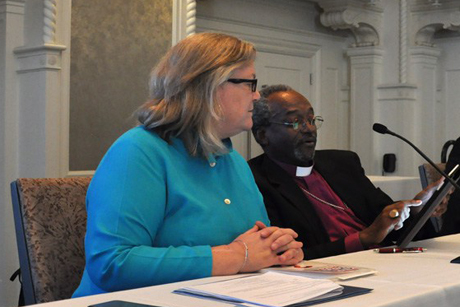
Photo Credit: Mary Frances Schjonberg / Episcopal News Service
[Episcopal News Service, by Mary Frances Schjonberg] The House of Bishops, the House of Deputies and the Executive Council of the US-based Episcopal Church heard yesterday (Thursday) about efforts to shift the culture of the denominational staff closer to that of the Jesus Movement.
Presiding Bishop Michael Curry and others also spoke about how the church’s culture at all levels can reflect the loving, liberating and life-giving way of Jesus.
Fear, mistrust and resentment have no place in such an organisation, Curry and House of Deputies President the Revd Gay Clark Jennings said of findings about the denominational staff’s culture in a two-hour presentation during the opening day of the House of Bishops’ 15 – 20 September meeting in Detroit, Michigan. Members of the House of Deputies joined the presentation via a webcast, making it what is believed to be the first time that the two houses have met together outside of General Convention.
Curry; Jennings; the Revd Michael Hunn, canon to the presiding bishop for ministry within the Episcopal Church; Tim Kuppler of Human Synergistics International; and Scott Beilke from Brighton Leadership Group, which partners with Human Synergistics, were the presenters. Several hundred remote viewers signed into the webcast, along with groups of remote viewers.
Curry said listeners should not get depressed by the news that major change is needed in the denominational staff’s culture. “Christianity is dysfunctional. That’s just the name of the game. I mean, it’s called being human,” he said. “How do we get from where we are to where Jesus the Christ is actually calling us to be?
“We’re not talking about [a] new programme,” Curry said. “This is not something that will be here today and gone tomorrow. The Jesus Movement isn’t anything new. It’s a call back to who we are, to the Jesus of the New Testament, to follow him in loving, life-giving and liberating ways; in loving, life-giving and liberating relationships with God, with each other and with all creation.”
As the church answers that call, “our evangelism will be real; as that happens our reconciliation will get serious” and “God only knows” what will be our impact on the world and all of creation, he said.
Jennings told the bishops earlier in the day that the members of the church’s leadership team that began the culture-change work “believe that it can help us become more fully the church that God is calling us to be. I even believe that it will help us, as the psalmist says, to heal the breaches.” She said the invitation to the deputies to join the bishops’ meeting for the presentation is “a mark of how far we have come together.”
During the afternoon presentation, Jennings said that such cultural change can continue only when “people are invited into a system that encourages transparency, accountability, kindness, and embodies the values that we’ve been talking about.”
“So, it’s going to take time. We can’t just say ‘Yeah, we’re going to be different.’ We actually have to be different and people have to experience it.”
The theme of the bishops’ fall meeting is “The Jesus Movement: Reconciling Reality and Ideal.” On 16 September, the bishops will learn how the Human Synergistics’ findings might apply in their dioceses in a session titled “Becoming the Jesus Movement Culture.”
While Human Synergistics was hired after an investigation of staff complaints that were made last Autumn about the work practices of three senior managers at the Church Centre in New York, Curry told Episcopal News Service the day before the presentation that the decision was broadly based on addressing the need for any church organisation in a leadership transition to examine its culture.
“This isn’t about what happened in the last year or in the last 10 years or in the last 20 years. There are accumulations over time in any organisation, in any community, in any family,” he said, characterising the issues as systemic and “much bigger than any of us or any of the people and players in the past.”
“The truth is I think we would have been doing this [work] in some way, shape, manner or form even if the things that happened late last year hadn’t have happened,” Curry said. “I think I would have come to the conclusion that we’ve got some work to do anyway. This hastened it.”
The ultimate question, he said, for leaders of the church at all levels is “how do we embody the teaching and the spirit of Jesus of Nazareth in the ways we do God’s business?”
- Click here to read Mary Frances Schjonberg’s full in-depth report on ENS