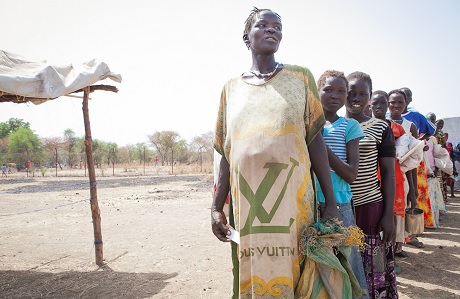
Photo Credit: Faith2Share
By Bellah Zulu, ACNS
The Episcopal Church of South Sudan (ECSSS) with the support of Episcopal Relief and Development has continued to give humanitarian support to the people displaced by the current crisis in South Sudan.
The Church’s relief and development arm the Sudanese Development and Relief Agency (SUDRA) reports that nearly 76,000 people from Bor are currently sheltering at churches, schools and under trees in Awerial county.
“The scale of the displacement, combined with limited local resources and infrastructure for absorbing large populations at short notice, presents numerous challenges,” said Program Officer for Episcopal Relief & Development, Nagulan Nesiah.
“People look to the Church for care and leadership in times of crisis, and ECSSS has responded wholeheartedly, opening doors and mobilizing available resources to help those in need,” he added.
The Episcopal Church of South Sudan and Sudan has since established nine relief centers in Awerial to provide supplies and pastoral care to people who have fled violence in the nearby town of Bor.
The most recent outbreak of civil unrest in South Sudan erupted on December 15, 2013, in the country’s capital, Juba. Conflict between two armed elements within the South Sudan Presidential Guard – one loyal to President Salva Kiir and one to former Vice President Riek Machar – spread from Juba through seven out of the country’s ten states.
Clashes between the two groups over control of key towns such as Bor and Malakal has led to the displacement of around 194,000 people. Some have crossed into neighboring countries, and approximately 54,000 are seeking refuge at UN bases inside South Sudan, but thousands are sheltering out in the open with little security and scant supplies.
In Awerial, the church compound alone is housing nearly 16,000 people, with many more in adjacent open areas. Scarcity of food is a major concern both in the displacement camps and in the town, due to the sudden large influx of people from Bor, and children are particularly at risk of malnutrition.
“Accessing contested and rebel-held areas has not been possible due to the security situation, so assessment of humanitarian needs by outside actors has been extremely limited,” said Nesiah.
“However, because the Church has long-term presence and deep relationships in these communities, it has been able to gather and relay information that is extremely valuable in planning a coordinated, large-scale response.”
The Church in Awerial is providing logistical and pastoral support for displaced people, with youth volunteers helping to assess needs and organize services in the camps. In addition to food, there is acute need for shelter materials, cooking utensils, medical care and adequate water and sanitation.
Episcopal Relief & Development anticipates a broader proposal from ECSSS and SUDRA to address food, shelter and healthcare needs for internally displaced people across the conflict region while SUDRA will concentrate on identifying and filling gaps in services provided by the UN and other emergency response organizations.
Relief activities are planned within the context of the Church’s long-term development programs, which aim to empower vulnerable and marginalized people to make sustainable improvements in their lives and communities.
Episcopal Relief & Development’s Senior Vice President for Programs, Abagail Nelson said, “Episcopal Relief & Development has been partnering with the Church and SUDRA since before the independence referendum to ensure that people returning to South Sudan would have spiritual and technical support to build thriving communities.”
She added: “We have been accompanying the Church as it builds its own capacity and networks to respond to emergencies like this, and SUDRA’s community-based development work has increased stability and resilience at the grassroots level.”
Episcopal Relief & Development works closely with the worldwide Church and ecumenical partners to help rebuild after disasters and to empower local communities to find lasting solutions that fight poverty, hunger and disease, including HIV/AIDS and malaria.
ENDS