Photo Credit: Marites N. Sison
By Marites N. Sison
Three indigenous peoples of faith have extolled the value of multi-faith work in Canada saying it not only provides opportunities to learn from others but also promotes healing and reconciliation among peoples and communities.
But they also acknowledged the need to do more to develop and strengthen relationships between aboriginal and non-aboriginal faiths and spiritual traditions.
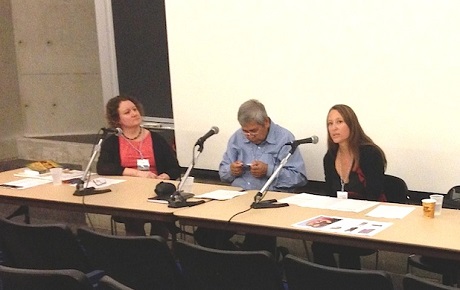
The Revd Andrew Wesley, Lori Ransom and Dawn Maracle on August 14 spoke about “Indigenous Experience and Diversity” at the North American Interfaith Network conference held at the University of Toronto’s Multi-Faith Centre.
They were asked to discuss the challenges of First Nations experiences for inter-faith work, to reflect on the gifts of indigenous spirituality and on how these gifts can be seen “in their integrity, without falling into appropriation.”
Maracle, a Mohawk from Tyendinaga, Mohawk Territory in southern Ontario, underscored the value of having native people on boards of organizations in order to get a balance of perspectives on discussions and decisions.
“A lot of times, if native people are brought in, they’re an afterthought…We’re plugged into a space as opposed to being part of the process from the very beginning,” said Maracle, who is an artist, writer, educator and consultant based in Ottawa.
She issued a challenge to Canadians: “Do a homelands assignment.” One of the reasons why people are disconnected from indigenous people is they don’t take the time to study the land that they’re living in, she said. “They don’t take time to understand the history, what was the culture that was there. And because of that disconnect, there’s a wall between them.”
Read more: http://bit.ly/1eP0qOc