The Archbishop Emeritus of Southern Africa, the Most Revd Desmond Tutu visited the Anglican Communion Office on Ash Wednesday to lead an intimate and reflective service of the imposition of the ashes. After the service, the archbishop spoke on a wide-range of issues that face the Anglican Communion, and of his belief in the Church’s future, his faith in human beings, and the central passion of his life - love - in an interview with ACNS.
“Anglicans must keep in mind that the chief characteristic of Anglicanism is that it is all inclusive,” he said to the staff of the Anglican Communion office. “It is especially important for Anglicans to promote this because the world finds it impossible to deal with diversity.” Jesus, he continued, had stated the most radical of ideas, that we are all of one family. “Everyone is an insider, there are no outsiders, whatever their beliefs whatever their colour, gender, or sexuality.” Worldwide Anglicanism is born out of diversity, and in this family, he added, we should be able to disagree with each other but not have people renounce the friendship that exists between us. “We all disagree on many things, but those that I disagree with are still my brothers, are still my sisters. That is the gift that Anglicans should be giving to the world.”
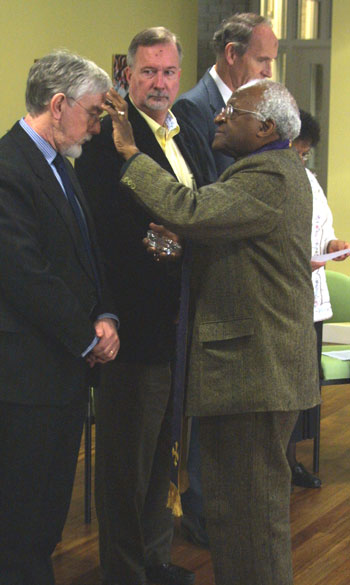
Archbishop Tutu imposes ashes during the service at ACO on
Ash Wednesday. (Rosenthal/Anglican World)
He said that the difficulties between the Episcopal Church of the United States (ECUSA) and the Province of the Church of Uganda, where the Ugandans had not wanted to allow representatives from ECUSA to attend the enthronement of their archbishop, had particularly pained him. It was so sad, he said. “Show me one family where there is always unanimity and I will show you liars. It should be ‘I don’t like your lifestyle, but you don’t stop being my brothers and sisters, whatever the disagreement.’”
He added however, that Anglicanism’s inclusive spirit should go beyond that of our own faith, because the world’s people – of whatever faith – needed to share their experience. “At this time, the world finds the difference between Christian and Muslim particularly difficult to handle.”
The archbishop went onto say that while the Anglican Communion was facing difficulties he knew that it would continue to grow. “The great evangelism work will mean our Anglican spirit will grow, especially in the poorer countries,” he said. “Richer countries – because of the constraints on time, because of the distractions that go through their lives – richer countries find it difficult to let God in.” Evangelism would be a harder task in wealthier countries.
It was not just that people found it more difficult to find God in the developed world but that people also found it difficult to admit their weaknesses and reconcile their vulnerability to God. “People find it hard to come to terms with 11 September. It happened because the perpetrators were human, just like you and me, not because they were something completely different. We must come to terms with difference; this is the example we set as Anglicans. We are all vulnerable, radically contingent, and there is only one invulnerable: God.”
On the issue of sexuality that currently divides the Communion, Desmond Tutu said that it was only natural this had become a dominating issue. “When there is confusion in the world, and complex, heart-breaking problems – such as HIV/AIDS, violence and poverty – people turn to issues on which they can have a black and white stance, because then they will be in close association with people of the same attitudes and they feel protected and safe. That’s why fundamentalism grows in periods of confusion. But this is not the answer. It is to admit vulnerability and to embrace your brother and sister with whom you disagree. But difference is seen as a threat.” Any issue that sought to exclude people from Church was wrong, he said.
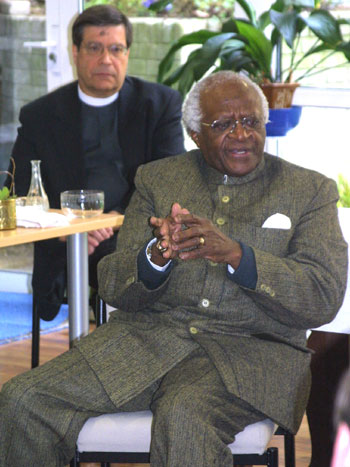
Archbishop Tutu speaks to staff. ACC Secretary General
Revd Canon John L. Peterson behind. Photo: Rosenthal/Anglican World
The archbishop also spoke movingly of the experience of justice in Post-Apartheid South Africa. He said that this had been an example of how people had violently disagreed but had now come together as brothers and sisters, although some differences remained. “You will not believe, but people whose families suffered at the hands of murderers have now embraced those that did them wrong, as brothers and sisters,” he said. “Retributive justice seems to prolong people’s suffering, but we tried to practice restorative justice; something that would bring people together.” Through restorative justice, he continued, people began to understand each other’s vulnerability and acknowledge their humanity. “The analogy is that when you are angry it’s bad for your health, but coming to terms with your anger can restore you to health,” he added.
“An enemy is a friend waiting to be made; that’s the only hope for this conflict-ridden world.”
Article By Michael Craske