By the Revd Canon Colin Craston
Former Chairman Anglican Consultative Council
18th May 2000 for ACNS
Lord Coggan
Donald Coggan was Archbishop of Canterbury for only six years, 1974-80. Before that he had been Archbishop of York for thirteen years after a spell as Bishop of Bradford for five years. He brought to his episcopal ministry considerable experience in theological training both in Canada and England. Prior to his consecration he was Principal of the London College of Divinity, later on its relocation to be known as St. John's College, Nottingham. In parochial ministry he had just one curacy at St. Mary's, Islington in London.
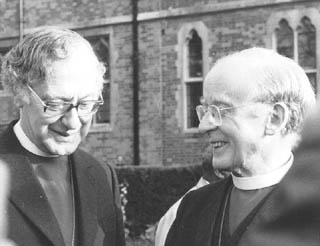
Lord Coggan (right) with Lord Runcie. (Photo: Canon Degwell Thomas) |
From within the Evangelical tradition he yet avoided the narrower constraints of many of that tradition around the middle decades of the twentieth century. The label "Open Evangelical", which now suits an increasing number as Evangelicalism has developed more broadly, could have justly been attributed to Donald Coggan throughout this ministry. While committed to the authority of Scripture in matters of faith and conduct, he recognised the role of sound leadership allied to Tradition and Reason, in seeking a right interpretation of Scripture in the life of the Church. It was within this commitment, rather than by following fashionable sociological trends, that he long ago came to support the cause of the ordination of women. In this he was warmly encouraged by his wife and his sister.
In several ways he was seen as in marked contrast to his predecessor at Canterbury, Michael Ramsey. Archbishop Michael was of the Catholic tradition. His public persona suggested an other-worldly detachment from the harsh demands of the modern world, a hesitancy in engaging in debate, yet the reality was of a sharp mind and firm grasp of priorities. Archbishop Donald came across as a kindly headmaster, or College Principal of a past generation, clearly pursuing his objectives. Both Archbishops' ministries were based on a deep spirituality, though of different Anglican traditions. And both were warmly committed to the ecumenical path to unity.
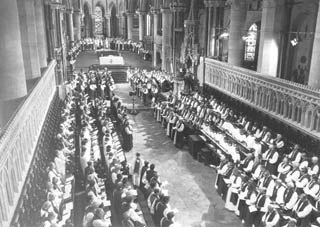
The Lambeth Conference 1978. (Photo: ACC) |
What Archbishop Donald specifically brought to his whole ministry was a passion for the mission and evangelism of the Church and a preaching gift based on biblical exposition. While at York and then at Canterbury he launched initiatives aimed at making the Church, Anglicans in cooperation with other Churches, more effective in commending the Gospel to a society drifting away from the faith. If the result was not what he hoped for, it was partly because he had not first got the wholehearted backing of his fellow-bishops. Towards the end of his time at Canterbury he was a prime mover in a National Initiative in Evangelism. The design was to bring together the broadest spectrum of Churches in stimulation of evangelism at the local church level. The British Council of Churches, a wide range of Evangelical Churches, many of them independent in church allegiance, with the cooperation of Roman Catholic representatives, sought a consensus of understanding of the Gospel and some coordination of programme in presenting it. In spite of the Archbishop's enthusiastic and sensitive leadership the Initiative faded out. Theological consensus between many of the independent Evangelicals and the broad coalition of the British Council of Churches failed to materialise. Finance to maintain the structures required was not forthcoming from the Churches. And Archbishop Donald's retirement from office removed his personal involvement. And yet it is possible to see that the whole project of the N.I.E. was far from a failure. It opened up a vision of cooperation between Churches never before working for unity in the Gospel, creating the atmosphere for the Decade of Evangelism and the wider ecumenical instruments of the Council of Churches of Britain and Ireland.
Dr Coggan put the highest priority on the preaching office in the Church. His own example of expository preaching was an inspiration and challenge to many. This writer remembers with gratitude Donald Coggan's series of expositions of the Prayers of St. Paul at a clergy conference over 40 years ago. Over twenty books flowed from his pen, many of them on the theme of the Word of God and the preaching of it in the modern world. His scholarship was widely recognised by universities across the world.
In his time at Canterbury the 1978 Lambeth Conference was held. If in retrospect it was not valued as highly as others, in recent times it could be because it came too early in his Archepiscopate for the more thorough preparation that was possible for the next two Conferences. One most beneficial result of the 1978 Conference was the launching at Donald Coggan's initiative of the Personal Emergencies Fund, for which was found the initial capital investment, to help clergy and families in the Third World facing medical emergencies.