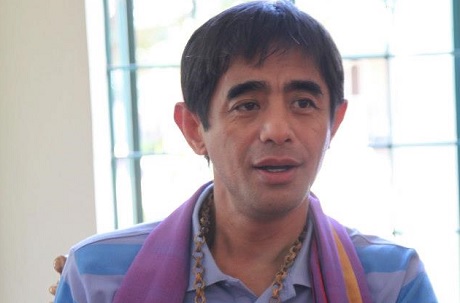
Photo Credit: The Episcopal Church
ACNS: What's your role at the Episcopal Church of the Philippines, and why are you visiting the UK?
FL: I am the Provincial Secretary and the National Development Officer. I am here to attend the US conference† which finishes on Wednesday. It is a time of sharing and I am hoping to learn a lot from the others who are there.
ACNS: Tell us more about the Episcopal Church in the Philippines.
FL:We are a small church, about 170,000 members. Seventy-five per cent of our members are indigenous people. We used to be part of The Episcopal Church in America, but we became independent in 1990. In recent years we have been working hard to become financially independent and now at last we are.
ACNS: How has that happened?
FL: The funding now comes from our members. It is a little bit like the ABCD* approach. Our Church asked 'what have we got' and how can we use that for the church.
ACNS: How does the ECP connect with society in the Philippines?
FL: In many ways. We have many challenges. We are living in a country with with massive social inequality, where there is a concentration of wealth in a few narrow sections of society. We work for a more equitable society.
ACNS: In what way?
FL: By giving people a broader vision of what they can acheive. People [mistakenly] believe that the work they are doing now will never achieve more developmentally because they have been doing it for years. We try and break that kind of thinking. For example, coffee should be an lucrative crop, but when we suggest to farmers that they prioritise growing it, they just look at us [questioningly]. People have lost their capacity to imagine, often they don't think beyond the next six months.
In one village they produce lots of sugar, but they insist on just giving it away. We asked what else they can do to raise income. They pointed out sweet potatoes, but it is seen as a poor man's food and they had not thought of selling it, only growing it to eat. When we suggested they could grow more and sell them, they said if they did they would have nothing to eat. We told them if they grew the crops we would buy them and advance them the payment while the potatoes were still growing so they could buy food in the mean time.
What happened was just one farmer raised five times what we expected and the money we paid her was used to pay off a debt she had owed for a long time. We fed typhoon victims with the surplus potatoes and gave the farmer back her dignity.
ACNS: Thanks for speaking to us.
****
Read more about Asset Based Community Development in the Philippines in The Episcopalian magazine http://www.episcopalchurchphilippines.com/1ecp2/files/Episcopalian_Easter_2013.pdf
*Asset-Based Community Development (alternatively known as CCMP, EMP or Umoja). The ABCD process encourages communities to focus on God's abundance, and to identify their gifts and capacities so they can devise their own development solutions.
†The Anglican Mission agency Us was formerly known as USPG